| Ten Sleep Canyon, Wyoming
"Big, Wonderful Wyoming" boasts the mud flaps on just about every truck sporting the bucking bronco and rodeo rider license plate. Wide open spaces, stark beauty, big sky, an ever-changing landscape, and ROCK. Every road traveled presents acres of stone to slow the climber on his relentless drive to the Tetons or beyond. Some of it is stellar, some, though, is ancient, weathered, scaly, rough and gnarly like the arms and hands of a seasoned rancher. This is the land of the erotically good, the distressingly bad and frighteningly ugly rock. |
 |
|
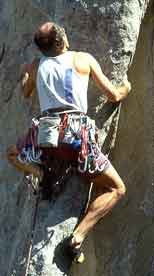
A climber’s festival goes “international” in Lander every year in mid July. People gather at Lander’s serene City Park as a shady base from which to venture out into the often-searing heat of Sinks Canyon in the late afternoon or Wild Iris at 9,000 feet in the morning, or both in one day. But what of the vast north central region of Wyoming? What’s up there besides the Big Horn Mts. and a lot of sheep, dodging bullets? Many years ago, Al Rubin, and I were on our way from Devils Tower to the Tetons. Having picked the shortest route on the map through Thermopolis, “The world’s largest mineral hot springs”, we anticipated wide open Wyoming grassland and sage. For 100 miles along Interstate 90, we weren’t disappointed. At the Buffalo exit, we picked up Rte. 16, to Worland. After fifty miles of rolling, forested hills and “mountains” we began a long descent through vast canyons of Dolomite – a limestone similar to Sinks Canyon. Endless walls of untouched, black, blue, and tan limestone stretched out along the highway from one end to the other. Ever since that day, I’ve wanted to return to climb. This is Ten Sleep Canyon and it’s experiencing a Renaissance. In the beginning, about a dozen years ago, at the western end of the canyon, between six and eight miles east of the small, cowboy town of Ten Sleep, several areas alongside the road were developed. Most routes are now bolted though quite a few still require all or some gear. Across from the first pullout is the Home Alone area that offers a wide range of grades in trad, sport, and mixed venues. All day shade is the main attraction plus brake dust incense and superb acoustics for the frequent Peterbilt and Harley symphonies. Shade is key. Most routes at Ten Sleep can’t be approached until 1pm in mid summer. Once in the shade, however, temperatures are quite reasonable and pleasant. However, always be prepared for fickle Wyoming weather and relentless wind. Climbing days for most sectors begin at between noon and 1:00, and last until the bugs, darkness or thirst for a beer overwhelms the need to send. Recommended routes at the Home Alone area are the wonderful 5.8, Home Alone, Plea Bargain at 10a, and Limestoned, 10d. Another area offering shade all day and moderate sport routes is the Raven Wall with its very own ice cave that the Native Americans once used to refrigerate meat. The Wall of Denial is nearby and shaded as well. The routes here are long, 13 – 15 bolters in the 5.11/5.12 range. Access is from pullouts 4, 5, and 6. Rock & Ice issue No. 93 has an excellent mini guide for the routes along the lower canyon of Ten Sleep up to and including earlier routes in the Mondo Beyondo and Valhalla sectors in the upper canyon accessed from the last pullout on the left. The upper canyon is where the new route activity has become intensive. At this time, there are a couple hundred bolted lines in the upper canyon alone. A guide exists to these new areas but is available only through “locals.” You could e-mail me at steveangelini@yahoo.com for a copy though it would be replete with my notations, corrections, additions, etc. I quickly surmised that Charlie is responsible for some of the cleanest, safest, and most aesthetic lines at Ten Sleep. Again, there is a bit of the good, the bad and the ugly here as at most new crags. As a local who was a pioneering route setter in the lower canyon was quoted as saying, "This here Dolomite takes a heap o' peelin'.". Some route setters leave this onerous task up to you. Several factions have wielded the Bosch on Ten Sleep stone and nobody wants to see their creation down rated. Locals out of Worland and Cody are at odds with the Lander boys. Then there is the gang from Denver who seem to have adopted Ten Sleep. Everyone has his or her own idea of what a rating should be. Expect sand in your vision both figuratively and literally (except on Charlie’s routes). The climbing is evenly distributed between tens, elevens and twelves and is of two sorts. The shark toothed, pointy, razor blade, merely vertical, rock similar to the Casino Wall at Jacks Canyon, AZ, or the deeply pocketed bulges and overhangs of Wild Iris. Some climbs feature both types. The most amazing new area is called the French Cattle Ranch. So named for the smooth, Verdon-like, blue, limestone available only here. Ali Rainey and Matt Wendling have been the chief activists at FCR. Except for three or four warm-ups in the 10/11 range, most routes here are in the 5.12 and up category. Several open projects await you at the 5.13 level. The Ten Sleep Festival has grown bigger and rowdier each of its four years of existence. It is always scheduled to take place the weekend before the ICF in Lander. This year that meant the four-day Independence Day, weekend, July 4-7. Free camping, two kegs of Snake River’s best ales and long mornings to sleep off the previous night’s revelry play a major part in the festival fun. Plus, Charlie’s a one-man band with the effervescence to match plus a truckload of rhythm toys enough for everyone. Bring yours if you have one. There’s a raffle and a slide show by Aaron Huey, master climber and route setter, master of the battery operated, toy guitar/synthesizer, ace photographer, tireless trans-continental trekker (coast to coast in six weeks this spring), and Renaissance man of wit, charm, talent and enthusiasm. In fact, everyone in attendance exuded ultra camaraderie and bubbling exuberance for the climbing here. It was great to have been a part of this group. They reminded me of my eastern fraternity of friends. The Real Skinny From the west (Ten Sleep and any of the canyon climbs and pullouts) drive to the top of the canyon. Just after crossing Ten Sleep Creek a small sign on the right indicates a “parking area” which abuts the dirt road to its left. Upon entering the road, a sign on the right advises that the road is closed from November 16 to June 15. This is only a slight problem to climbers visiting during these months since camping is available at pullouts, along dirt roads, and even in a gravel pit east toward Deerhaven. Although the crags are climbable in the winter, approaches may be snow covered. It would be better to climb the roadside sectors lower in the canyon during the snow season. When two miles of this smooth dirt road have been negotiated around and through the herds of cows, calves and bulls that roam the road and open range it travels through, good sites will begin to reveal themselves mostly on the left side of the road within the first and second stands of timber. This dirt road continues down to the mouth of the canyon where a couple of small and expensive campgrounds are located near a fish hatchery. The dirt road may be accessed from the main highway at this end as well. Ten Sleep needs routes on the east side of the canyon that is shaded in the morning. The rock and potential looks equal to and as limitless as the opposite, west side. There’s room enough here for everyone with a drill. Two hundred routes today, two thousand routes tomorrow. Stay tuned. See you next year at the festival |
|